CalculateTriggerForDeltaY
ID: Calculate/CalculateTriggerForDeltaY
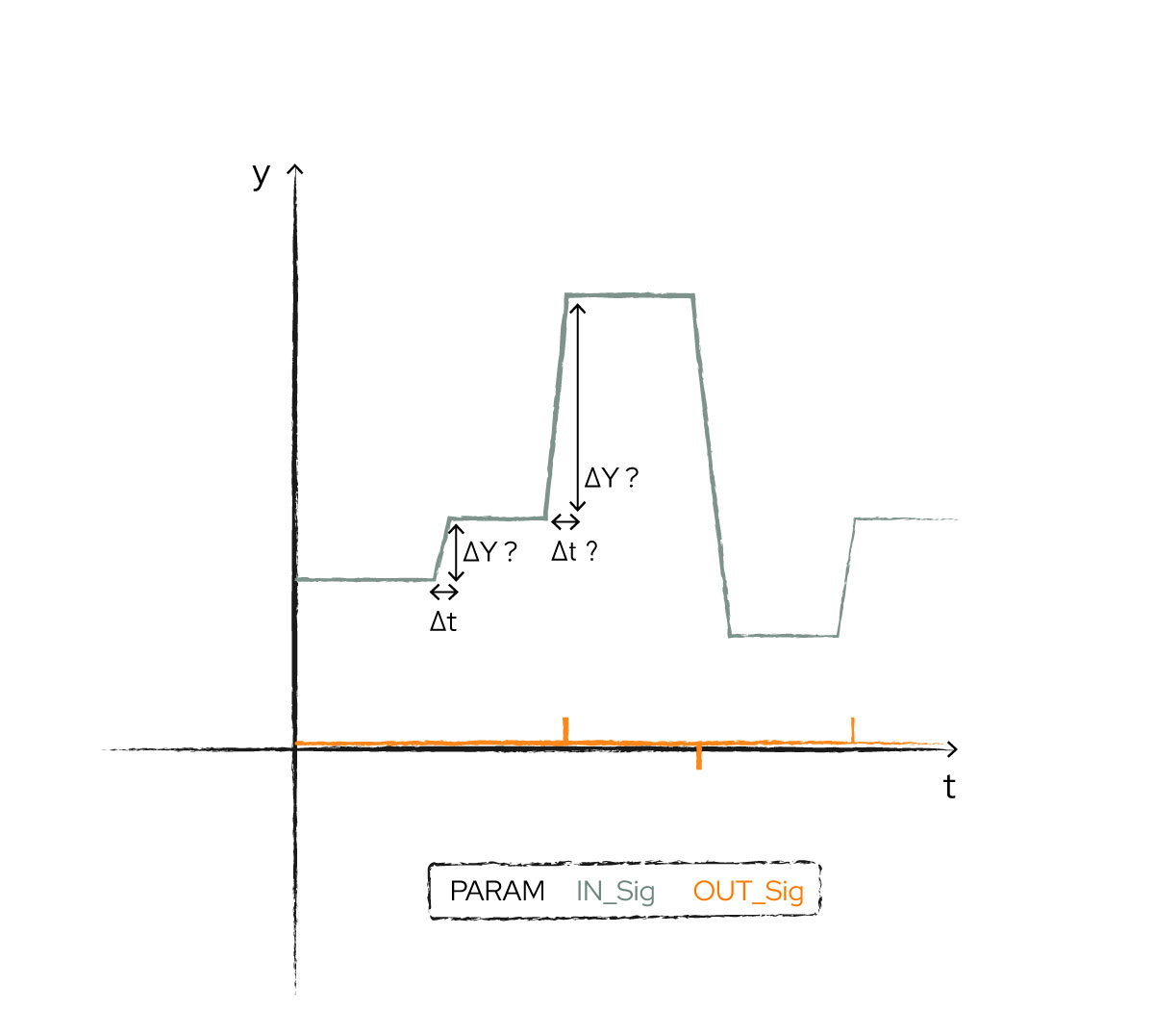
This trace step template is used for the detection of jumps in the input signal. In a sliding time interval of length deltaX it will searched for:
Ascending jumps: minDeltaY <= y - min(interval) <= maxDeltaY, and
Descending jumps: minDeltaY <= max(interval) - y <= maxDeltaY,
where
y is the current signal value (the newest value in the time interval)
min(interval) is the minimal signal value of the time interval
max(interval) is the maximum signal value of the time interval
deltaX >= 0
maxDeltaY >= minDeltaY >= 0
The trace step template provides an output signal DeltaSignal, which indicates
an ascending jump as value 1
a descending jump as value -1
no jump as value 0
Signals
Signal
The signal to analyze
Direction: IN
Optional: False
DeltaSignal
A signal which indicates the detection of an ascending jump (value: 1), a descending jump (value: -1) or no jump (value: 0)
Direction: OUT
Optional: False
Parameters
deltaX
[int or float] The length of the sliding time interval. The value has to be >= 0.
Direction: IN
minDeltaY
[int or float] Minimum difference for the signal value to be detected as jump. The value has to be >= 0.
Direction: IN
maxDeltaY
[int or float] Maximum difference for the signal value to be detected as jump. The value has to be >= minDeltaY.
Direction: IN
autoExpandDeltaX
[bool] If true, the deltaX time interval will automatically be expanded such that the last sample that occured right before the declared deltaX time interval will also be included. Default: False
Direction: IN